What is Forex Trading and How does it Work?

Forex trading refers to the process of exchanging one country’s currency for another within the foreign exchange market. In this market, traders convert funds from one currency into a different currency to profit from changes in exchange rates.

What is Forex Trading?

Forex trading is the process of exchanging one country’s currency for another within the global foreign exchange market. Traders convert funds from one currency into another with the aim of benefiting from fluctuations in exchange rates—without the complexities often associated with investing in stocks or commodities.

The forex market is unique because it is accessible to everyone, not just professional traders or financial institutions. Individuals around the world can participate through trusted online brokers such as alpha prime fx, gaining access to advanced trading platforms, educational resources, market insights, and the opportunity to learn from experienced traders.

In fact, if you have ever purchased goods priced in a different currency, you have already taken part in the foreign exchange market. Whether the conversion occurred instantly through a credit or debit card transaction, or earlier when exchanging physical cash before traveling, the currency exchange process is fundamentally the same. Through platforms like alpha prime fx, traders can actively engage in this global market with greater confidence, efficiency, and strategic support.

What is the Forex Market?

The foreign exchange market is a global marketplace where participants buy, sell, exchange, and speculate on currencies. It includes major financial institutions such as banks, central banks, investment management firms, hedge funds, multinational corporations, and individual investors, as well as retail forex brokers.

Key players in this market are commercial banks, authorized dealers, monetary authorities, and online forex brokers. Although the forex market operates worldwide without a single central location, trading centers across different countries remain closely connected, ensuring continuous communication and seamless transactions around the clock.

To trade effectively, it is important to understand the core components of the forex market. These include currency pairs, pricing quotes, and the mechanics of trade execution. Traders work with major, minor, and exotic currency pairs, while also analyzing bid and ask prices and the spread, which directly affects trading costs. By learning how to place buy and sell orders through a broker and how to speculate on currency price movements, traders can build a solid foundation in the fundamentals of forex trading and approach the market with greater confidence.

Understand Currency Pairs

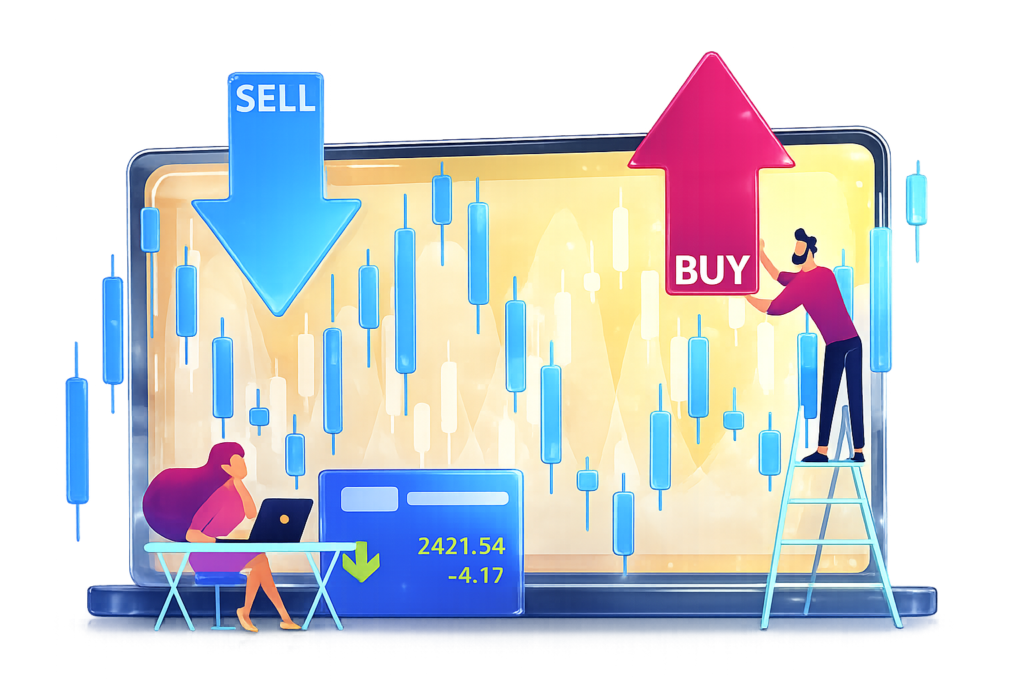
In forex trading, currencies are always traded in pairs, meaning one currency is bought while another is sold at the same time. When a trader buys a currency pair, they purchase the base currency and simultaneously sell the quote currency. The bid price represents how much of the quote currency is required to obtain one unit of the base currency.

Conversely, when a trader sells a currency pair, they sell the base currency and receive the quote currency in return. The selling price reflects how much of the quote currency is received for one unit of the base currency.

In essence, every forex transaction involves exchanging one currency for another—selling one to buy the other—within the global foreign exchange market.

What are Base Currency and Quote Currency?

In the foreign exchange market, currency prices are quoted in pairs, known as currency pairs. The first currency listed in the pair is called the base currency, while the second is known as the quote currency. Currency pairs are typically displayed as six-letter combinations separated by a slash, such as XXX/YYY. In this format, XXX represents the base currency and YYY represents the quote currency.

Types of Currency Pairs - Major & Minor Currency Pairs

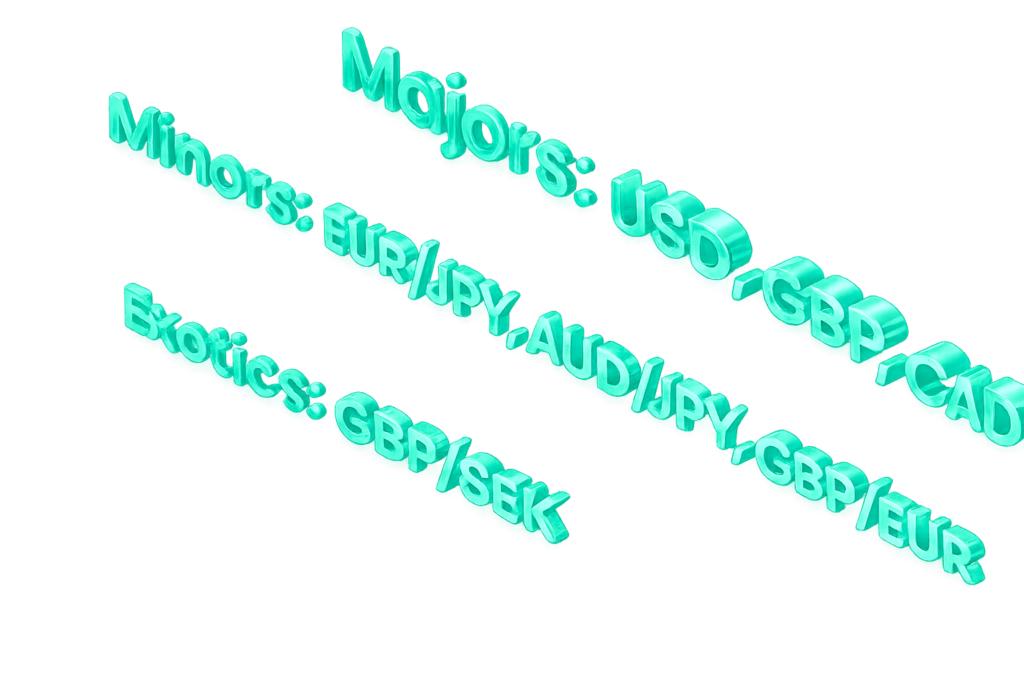
There are three main types of currency pairs: Majors, Minors, and Exotics.

Majors:
Major currency pairs are the most frequently traded currencies in the global forex market, which is why they are known as “majors.” These pairs are highly liquid and always include the U.S. Dollar (USD) traded against other leading global currencies such as the Euro (EUR), British Pound (GBP), Swiss Franc (CHF), Japanese Yen (JPY), Canadian Dollar (CAD), Australian Dollar (AUD), and New Zealand Dollar (NZD). Some of the most actively traded major pairs include EUR/USD, AUD/USD, and USD/CAD.

Minors:
Minor currency pairs, also known as cross-currency pairs, do not include the U.S. Dollar. They generally have lower liquidity compared to major pairs but are still widely traded. Examples of minor pairs include EUR/JPY, AUD/JPY, and GBP/EUR.

Exotics:
Exotic currency pairs consist of one major currency paired with a currency from a smaller or emerging economy. These pairs are typically less liquid and may have higher spreads due to lower trading volume. An example of an exotic pair is GBP/SEK.

Movements in the foreign exchange market are influenced by various factors, including economic growth, international trade activity, geopolitical developments, and changes in interest rates.

How Does Forex Trading Work?

Forex trading is similar to buying and selling other financial instruments like stocks, but the key difference is that currencies are traded in pairs, such as EUR/USD or GBP/JPY. In every forex transaction, one currency is sold while another is purchased simultaneously.

A trader makes a profit when the currency they buy increases in value relative to the currency they sell. For example, if the EUR/USD exchange rate is 1.40, it means 1 euro equals 1.40 U.S. dollars. If you purchase 1,000 euros, you would pay $1,400. If the exchange rate later rises to 1.50, you could sell those 1,000 euros for $1,500, earning a profit of $100 from the change in exchange rate.

Lot in Forex

In forex trading, currencies are traded in standardized units known as lots. A lot represents a specific quantity of the base currency and helps maintain consistency in trade sizes. Because currency prices typically move in small increments, lot sizes are generally large.

A standard lot equals 100,000 units of the base currency. Since most traders do not have the full capital required to trade such large amounts, forex trading commonly involves the use of leverage. Leverage allows traders to control larger positions with a smaller initial investment, making it possible to participate in the market without committing the full value of the trade upfront.

Spreads in Forex

In forex trading, the spread refers to the difference between the buy (ask) price and the sell (bid) price of a currency pair. When you open a position, you are always quoted two prices, as is common in most financial markets.

If you want to open a long (buy) position, you trade at the ask price, which is slightly higher than the current market price. If you want to open a short (sell) position, you trade at the bid price, which is slightly lower than the market price. The gap between these two prices represents the broker’s spread and is one of the primary costs of trading.

Pips in Forex

A pip is a unit of measurement used in foreign exchange trading to describe the difference in value between two currencies. Pip, which stands for “point in percentage,” is the lowest standardised movement that a currency quote can experience. Pips are a unit of measurement used by traders to describe their position’s profit or loss and to quantify the difference between the ask and bid prices of a currency pair.

A pip is often the fourth decimal place in major currencies, making a shift of one pip equal to 0.0001. A pip, however, is the second digit following the decimal point in some currencies, such as the Japanese Yen. Despite the fact that a pip is often the second or fourth decimal place, we frequently display a second decimal that represents a fraction of a pip.

Margin in Forex

In forex trading, margin requirements are typically expressed as a percentage and determine how much leverage a trader can access through a broker. The margin requirement indicates the portion of the total trade value that must be deposited to open and maintain a position.

Margin is essentially the initial capital a trader must allocate to initiate a leveraged trade. Instead of paying the full value of a position, traders only commit a small percentage, allowing them to control a larger amount in the market. It is important to understand that margin is not a fee or trading cost—it is a security deposit held by the broker while the position remains open.

Leverage in Forex

Leverage allows traders to control a large market position with only a small initial deposit, rather than paying the full value of the trade upfront. By using borrowed capital from a broker, traders can increase their market exposure while committing a relatively limited amount of their own funds.

When a leveraged position is closed, profits or losses are calculated based on the full size of the trade, not just the initial deposit. While leverage can significantly amplify potential returns, it also increases the risk of larger losses—possibly exceeding the initial margin. For this reason, effective risk management is essential when trading with leverage.

Type of Charts in Forex Trading

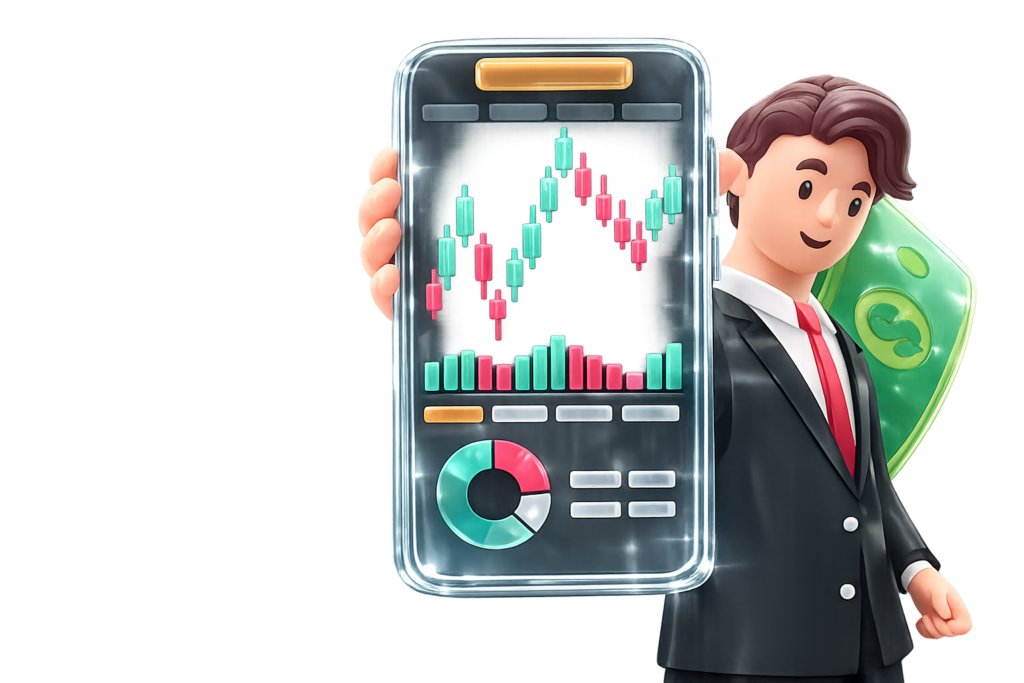
Forex charts play a vital role in analyzing currency market movements. They visually represent how exchange rates fluctuate over time, enabling traders to identify trends, patterns, and potential entry or exit points. By studying charts, traders can make more informed and strategic trading decisions.

There are three primary categories of forex charts: time-based charts, activity-based charts, and price-based charts. Each type presents market data in a different way, offering unique insights into price behavior and overall market conditions.

Time-based charts

The most popular kinds of trading charts.

Line charts:

A line linking closing prices.

Bar charts:

A vertical bar representing each period’s open, high, low, and close (OHLC).

Candlesticks:

Showing the high and low as “wicks” and each period of open and close range as a vertical block.

Volume charts:

Each candle is made when the volume changes by a certain amount.

Tick charts:

A specific number of ticks or transactions are shown by each candle.

Volume profiles:

Combine time-based and volume-based charts to display the volume traded at various price levels.

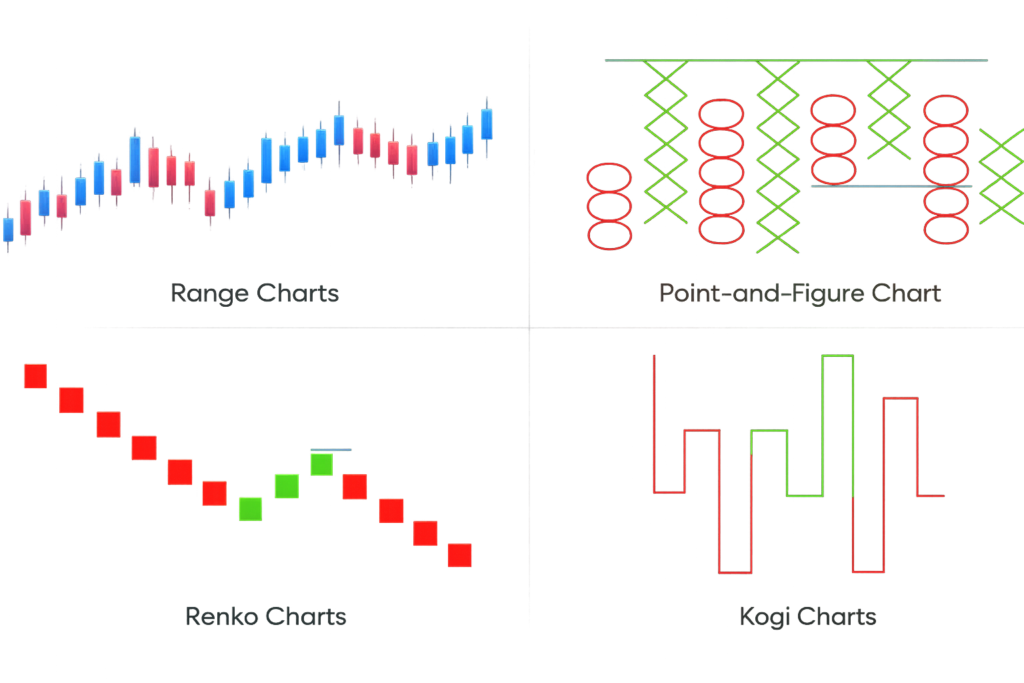
Price-based charts

Range charts:

When the price changes by a predetermined price range, such as 100 pip, a bar or candle is formed.

Point-and-Figure charts:

Rising prices are represented by X columns, and falling prices are represented by O columns.

Renko charts:

When the price has moved a specific amount from the preceding brick, these charts—which resemble a succession of bricks—print.

Kagi charts:

They swivel after the price moves in the opposite way by a specific amount.

Forex Trading Platforms

In the forex market, traders access currency pairs through advanced trading software equipped with analytical tools, charting features, and technical indicators. The two most popular platforms used globally are MetaTrader 4 (MT4) and MetaTrader 5 (MT5).

Both platforms were developed by MetaQuotes. MT4, introduced in 2005, quickly became a preferred choice among forex traders due to its user-friendly interface and strong analytical capabilities. In 2010, MetaQuotes launched MT5 as a more advanced successor, offering additional features and expanded market access. Despite MT5’s enhanced functionality, MT4 remains widely used and continues to be supported by many brokers worldwide.

MT4 has long been considered an industry benchmark, with a large portion of forex brokers offering it as their primary trading platform. Over the years, it has been continuously upgraded with new tools and improvements. While MT5 provides more advanced features and broader asset coverage, understanding the differences between MT4 and MT5 can help traders choose the platform that best suits their trading strategy and goals.

MT5

In the forex market, traders access currency pairs through advanced trading software equipped with analytical tools, charting features, and technical indicators. The two most popular platforms used globally are MetaTrader 4 (MT4) and MetaTrader 5 (MT5).

Both platforms were developed by MetaQuotes. MT4, introduced in 2005, quickly became a preferred choice among forex traders due to its user-friendly interface and strong analytical capabilities. In 2010, MetaQuotes launched MT5 as a more advanced successor, offering additional features and expanded market access. Despite MT5’s enhanced functionality, MT4 remains widely used and continues to be supported by many brokers worldwide.

MT4 has long been considered an industry benchmark, with a large portion of forex brokers offering it as their primary trading platform. Over the years, it has been continuously upgraded with new tools and improvements. While MT5 provides more advanced features and broader asset coverage, understanding the differences between MT4 and MT5 can help traders choose the platform that best suits their trading strategy and goals.

Become a part of our update community...

Trade global markets with confidence through advanced technology, competitive spreads, and secure transactions at AlphaPrimeFX

Social Connect

Brand Name

Alpha Prime FX is the official brand operating this website and providing online trading services.

About Alpha Prime FX

Alpha Prime FX offers access to global financial markets, including Forex, CFDs, Indices, Commodities, and Cryptocurrencies through a secure and innovative trading platform.

Regional Restrictions

Alpha Prime FX does not provide services to residents of certain jurisdictions, including but not limited to the United States of America, Canada, Israel, North Korea, and Saint Vincent & The Grenadines. The information on this website is not directed at individuals in any country or jurisdiction where such distribution or use would be contrary to local law or regulation.

Risk Warning

Trading Forex and financial instruments involves a high level of risk and may not be suitable for all investors. Leverage can work both for and against you. You may lose part or all of your invested capital. Before trading, carefully consider your investment objectives, experience level, and risk tolerance, and ensure you fully understand the risks involved.

Disclaimer

The information provided on this website is for general informational purposes only and does not constitute investment advice, financial recommendations, or a solicitation to engage in financial services in jurisdictions where such activities would be unlawful.

Language & Translation Notice

This website may provide multilingual content for convenience. In the event of any discrepancy, the English version shall prevail.

Regulatory Notice

Regulatory requirements and investor protection provisions may vary depending on the jurisdiction in which services are offered.

Intellectual Property

All content, materials, and intellectual property on this website are the property of Alpha Prime FX and may not be reproduced without prior written permission.